RunwayIQ
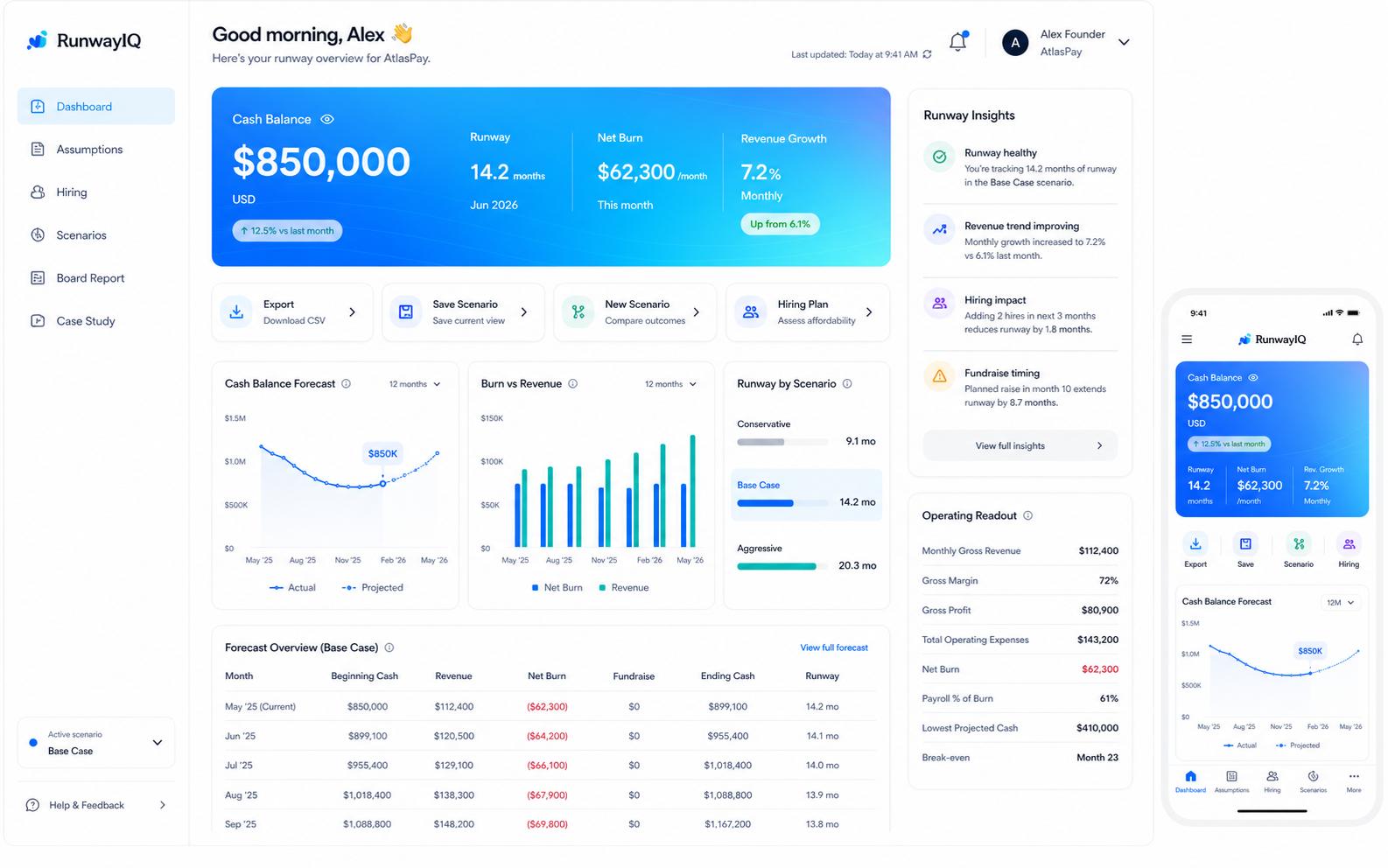
I built RunwayIQ to turn operating assumptions into a cash picture that can be explored. The prototype connects revenue, spending, and hiring choices so a reviewer can compare scenarios instead of relying on one fixed forecast.
My role
I designed the financial-modeling approach and user experience, and built the prototype with AI-assisted development.
Status
Working prototype · Synthetic scenarios
Capabilities
Financial modeling · Scenario analysis · Decision support
The problem
A runway estimate becomes more useful when the reviewer can see what drives it. Hiring timing, revenue expectations, and recurring costs should be visible assumptions, not unexplained numbers in a final chart.
What I worked on
A scenario-planning prototype for examining cash runway and operating choices using synthetic company data. The interface brings the assumptions and their financial implications together, with a focus on making the model understandable to an operator.
Decisions and tradeoffs
Put the assumptions next to the output
The model should help someone question the forecast, not simply accept a polished result.
Compare choices without claiming certainty
Different operating assumptions produce different scenarios. The purpose is to make the tradeoff visible, not to claim that one forecast predicts the business.
Keep the finance legible
A useful interface supports financial reasoning. It does not replace the need to understand the calculation.
Evidence and scope
RunwayIQ is a planning prototype shown with synthetic scenarios. It is not presented as a company’s actual financial plan, a record of customer adoption, or evidence of measured savings.
What this shows
Financial modeling, the ability to translate an operating question into a usable tool, and attention to how someone else will interpret the result.
See the work