SignalDesk + FrictionLab
I built two connected B2B tools around one rule: a number should be traceable to the evidence behind it. SignalDesk prioritizes accounts using cited official documentation, and FrictionLab turns onboarding drop-offs into decisions that someone reviews and approves.
My role
I defined the scoring rules, evidence standards, and review workflow, and directed the build using AI coding assistants.
Status
Working prototype · Public documentation research
Capabilities
GTM analysis · Funnel diagnostics · Evidence tracing
The problem
Account scores are easy to produce and hard to trust when nobody can see where they came from. Onboarding analytics have a similar gap: a funnel chart shows where people leave, but not which change to make or whether anyone reviewed the reasoning.
What I worked on
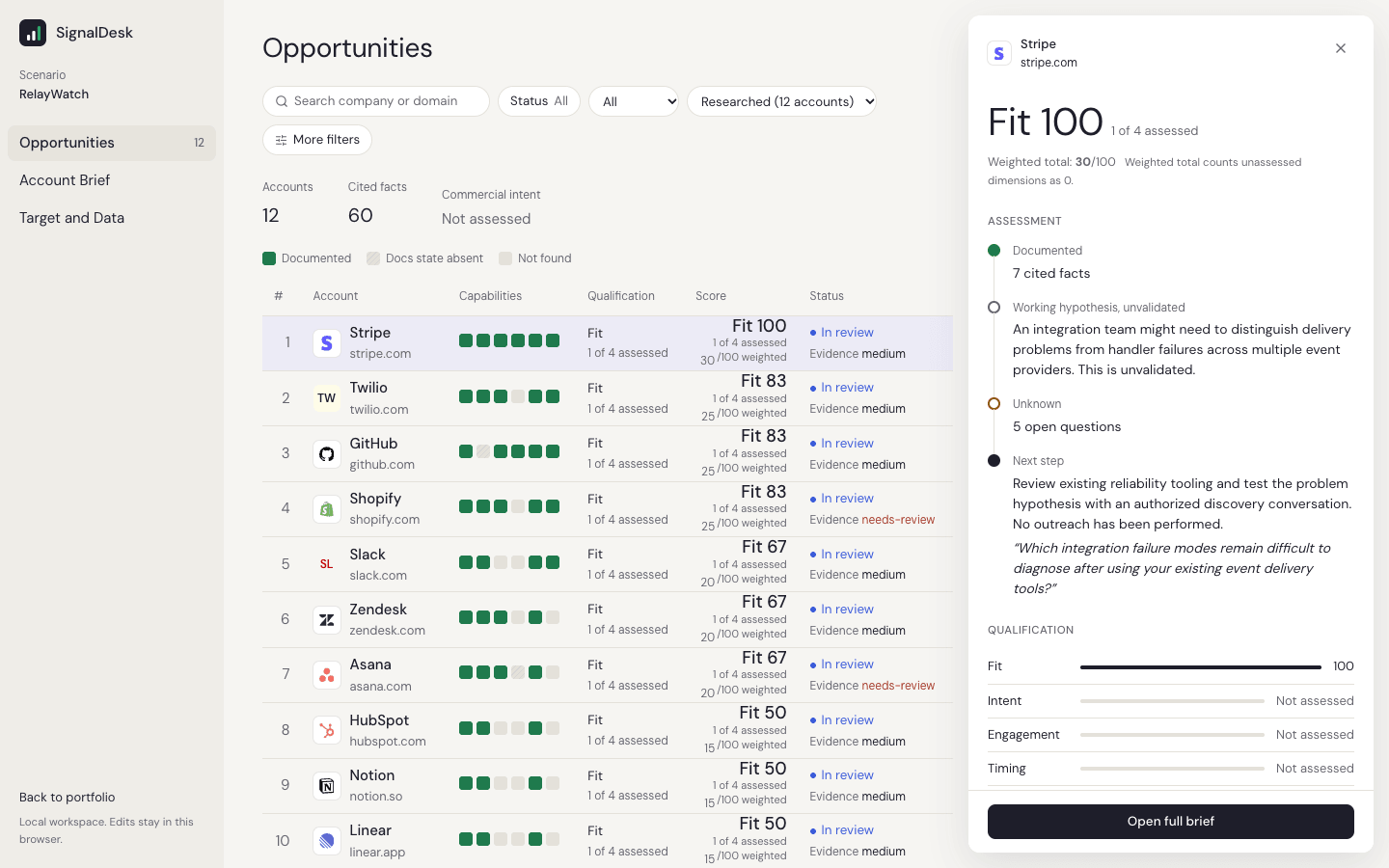
SignalDesk scores accounts on six webhook capabilities documented across twelve vendors' official docs, and each fit score links back to a cited fact. Intent and timing are marked "Not assessed" and never guessed. FrictionLab computes funnel metrics over a fixed seven-day cohort window, groups feedback into rule-based themes, and resets an approval when the underlying evidence changes. Both are built in React, TypeScript, and Vite.
Decisions and tradeoffs
Mark what was not assessed
Intent and timing cannot be established from public documentation. The tool shows them as not assessed instead of filling the gap with an estimate.
Reset approval when evidence changes
A reviewed decision should only stay approved while the evidence it relied on is unchanged. Changed evidence sends it back for review.
Keep the analysis rule-based and inspectable
Feedback themes and funnel figures follow fixed, documented rules and a fixed cohort window, so a reviewer can reproduce any number shown.
Evidence and scope
A working prototype using researched public documentation and synthetic funnel data. It makes no commercial intent claims, and the portfolio does not present it as a deployed product, customer result, or measured improvement in conversion. The project has 163 unit tests and a 74-check end-to-end suite.
What this shows
Evidence discipline in GTM analysis, funnel and cohort reasoning, and the ability to turn a vague analytical question into a tool with explicit review steps.
See the work
Implementation details
Key subsystems
- Six webhook capabilities researched across twelve vendors' official docs
- Fit scoring with every cited fact traceable to its source
- Funnel metrics over a fixed seven-day cohort window
- Rule-based feedback themes with approval that resets on new evidence